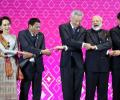
The prime minister also welcomed convergence of views between India and ASEAN for cooperation in the Indo-Pacific region.

The prime minister will have a tight schedule in the Philippines as besides attending the 15th ASEAN-India summit and 12th East Asia summit on November 14, he will have a series of other engagements including bilateral meetings with several leaders.

As Japan beefs up its defences against China, both New Delhi and Tokyo seem to have decided to re-energise their relationship to ensure a strategic balance in Asia. It is a clear signal that they may be ready to work together in containing if not confronting China, says Nitin Gokhale.

PM Modi seems to be gradually ending India's strategic ambiguity

World Bank's Doing Business Indicators ranks India (out of 189) at 132 for trading across borders.
India has been forcefully raising the issue of market access as well as protected lists of goods mainly to shield its domestic market as there have been fears that the country may be flooded with cheap Chinese agricultural and industrial products once it signs the deal.

Modi held talks with Abe after arriving in the Laotian capital to attend the Association of Southeast Asian Nations-India and the East Asia summits that will take place on Thursday.


'China feels India will be hard-pressed not to go after China because we are so badly dependent on them -- and that is the reality.'
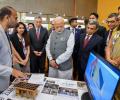
He said that India will work with Singapore to bring the Regional Comprehensive Economic Partnership to early conclusion. He also said the India-Singapore Comprehensive Economic Cooperation Agreement has been reviewed and the two sides will work to further upgrade it.
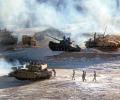
India's national security strategy needs to be revised periodically since the global and regional geopolitical situation is dynamic, points out Commodore Venugopal Menon (retd).
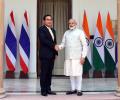
Thailand's importance to India's Act East policy is too significant to be overlooked.
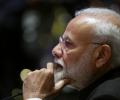
'It seems a wiser decision to pull out at the right moment than regret after joining the pact,' explains Dr Rahul Mishra.

Modi will have a number of high-profile multilateral and bilateral meetings with global leaders including United States Vice President Mike Pence and Singapore premier Lee Hsein Loong.
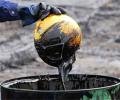
The Indian desire to deepen its ties with Vietnam, especially in the oil sector, besides defence and trade, was conveyed to the top leadership in Hanoi by External Affairs Minister Sushma Swaraj.
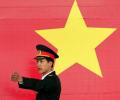
Modi's Vietnam visit is timely and crucial for several reasons. First, Vietnam lies at the heart of India's vision for Southeast Asia as also its 'Act East' policy. India also wants to boost its defence exports to friendly countries. And it is looking to increase trade between the two countries will now is only $7.83 billion, says Dr Rahul Mishra.

Asked for China's comments on India not joining the RCEP deal over concern of cheap Chinese products potentially harming its domestic industry, Chinese foreign ministry spokesman Geng Shuang told the media in Beijing on Tuesday that China welcomes India joining the deal.

It is often said that the India-Indonesia relationship is overshadowed by mutual neglect.

Had India agreed to join the trade pact, Indian markets would have been flooded with cheap Chinese products.

It is important the SCO focus strongly on economic development and regional integration that leads to greater benefits for the least developed regions of member-countries, writes Sana Hashmi.

India will look to play a key role in the APEC, EU and Africa regions to increase its competitiveness.

Making it easier to do business is a key element of our strategy, says Foreign Secretary S Jaishankar.

India should enhance its economic, cultural and defence ties with Mongolia. It is high time Modi should focus on gaining clout in smaller Asian countries such as Mongolia. It is in this context, India's engagement with Mongolia would give much-needed impetus to India's foreign policy, says Sana Hashmi.

New Delhi has reached out to neighbours like seldom before while singling Islamabad for criticism at international forums.

The agreement on services, if ratified by all member countries, could prove to be a game changer for Indian professionals in education, healthcare & IT.
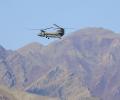
'Our strategy should be to 'hold the line' in the north on the Sino-Indian land frontier, but maintain and, if possible, enlarge India's current edge in the maritime south.'

It seems China is ready to cooperate with India in the central Asian region through the SCO framework, the reasons for which are manifold, says Sana Hashmi.

'Even if such a thing happens, it will not prolong for many days like Doklam did.' 'That is because both the leaders do not want it.'

The 2 countries signed 15 agreements including one on defence cooperation after Prime Minister Narendra Modi held 'productive discussions' with President Joko Widodo.

The counter-insurgency operation on the Indo-Myanmar was under planning for the last three months. The June 4 ambush that killed 18 Indian soldiers only hastened the attack. Sheela Bhatt provides exclusive details of the planning for the operation.

The developments in Af-Pak region, particularly the fall out of Pak political paralysis, would make President Xi Jinping's task a little more complicated, says Colonel R Hariharan.

'Whether it's investments in Kashmir, building naval facilities, or selling top-of-the-range military equipment, Pakistan could well benefit more under Xi's watch.' 'Do Chinese concerns about the 'Islamisation' of Pakistan give it pause about how quickly to move forward with security and economic projects? At the moment the indication is quite the opposite: China is doubling down on its support to Pakistan, partly because of its fears about where the country is headed.'
 © 2026 Rediff.com - Advertise with us - Disclaimer - Privacy Policy - Sitemap - Feedback - About us - Terms of use - Grievances